
[this is a revised version of a post I wrote for my work]
I started taking mental health as a topic seriously when I started working at Flinders. Yes, it was part of my training as a psychologist, but my career had kept me on the periphery of the topic for a long time, at least as far as what an individual might do to look after their mental health.
The further I dug into the topic, the bigger I realised the topic is. On the plus side, this means there is always something interesting to learn. I am as much a student of the topic as I am someone that teaches it. On the downside, it means when I am asked to comment on how people look after their mental health, I often don’t know where to start 😖
In my work, I get many opportunities to speak to university students about their mental health. I typically get about an hour, on average. That is a reasonable length of time to speak, but not very much to provide a comprehensive AND practical overview of the topic. So, I am always playing with new ways to approach the topic.
Recently I’ve been using a ‘4-step’ narrative that seems to work OK. So I thought I’d share it here with the hope it might be helpful to someone
Self-care for Mental Health – A 4-step Plan
I start by recognising that mental health is a multi-dimensional concept. There isn’t universal agreement on the definition of mental health, but common features include:
- Feeling good – experiencing positive emotions and having the capacity to manage difficult ones
- Functioning well in the different domains of your life
- Having strong relationships and feeling like you belong
- Managing mental ill health (illness) if it arises
- Being resilient to stress and setbacks
- Understanding and accepting yourself
- Making good choices and decisions and being able to follow through with healthy behaviours
- Having a sense of meaning and purpose
To have ‘good mental health’ therefore is to feel you are net positive across these areas. Having ‘poor mental health’ would mean running net negative. Whilst some areas can be measured objectively, it is the subjective experience of the individual person that is the focus here. Mental health is how you think and feel about yourself, others, your life and your future.
The term ‘self-care’ in this context relates to the deliberate, intentional decisions and actions you take to improve how you are doing in these domains. Your mental health is subject to many forces, some out of your control. Self-care involves acting on those that are within your control.
Mental health is relevant to everyone
I trained to diagnose and treat different mental illnesses. So, for a long time, I equated mental health with mental illness. Even by that limited definition, mental health would end up being a topic of relevance to everyone. For example, in Australia 43.7% of the population will have a mental disorder at some point in their life. We’d either be directly affected or care for someone who is.
But if you take mental health as per the expanded description above, the domains apply to everyone. Each of us has a mind and the health of that mind is our mental health. You might, as a reader, be able to identify times in your life when things were going well in at least some of those domains and where you felt satisfied with your life. Conversely, when things weren’t going to plan in those domains, life feels a lot harder.
You can influence your mental health
Whilst many factors influence your mental health, and some of them are out of your control, you can, through good self-care positively influence your mental health.
As you were growing up, parents/ friends/ teachers/ family/ mentors might have taught you how to do this. Or maybe they didn’t. There is significant variation between individuals, cultures, and generations in the extent to which mental health is discussed openly and people are given opportunities to learn how to care for their minds.
The good news is, even if you weren’t taught how to look after your mental health growing up, you can always learn. I was 40 before I really started paying attention to it in my own life.
So, what can I do to look after my mental health?
That is where the 4-steps come in. To be clear, there isn’t anything magical about these 4-steps. I won’t be publishing a self-help book and doing a world tour on these four steps.
The steps are simply intended to try to give people an actionable entry point into making some investments in their mental health. Start small, build up if necessary. The first couple of steps are things you could easily do on your own. The last 2 would likely require you to do a little bit of learning or reach out for assistance.
Step 1 – add stress reducing activities to your day
A simple starting point in terms of improving your mental health is to add stress reducing activities to your day.
This is a grossly over-simplified explanation, but your nervous system has a branch called the autonomic nervous system (ANS). It controls the automatic functions of your body that are needed for survival. The autonomic nervous system is further sub-divided into the sympathetic nervous system (SNS) and the parasympathetic nervous system (PNS). The SNS is what fires up when you have a challenge, stressor or threat present. The PNS activates so you can rest and restore.
A healthy and well-calibrated nervous system can switch between the two. SNS turns on to get you fired up to take on the challenges of the day. PNS downregulates things to provide the necessary rest and restore. This would be the top line of this diagram with peaks of stress needed to get stuff done and troughs of recovery and rest.
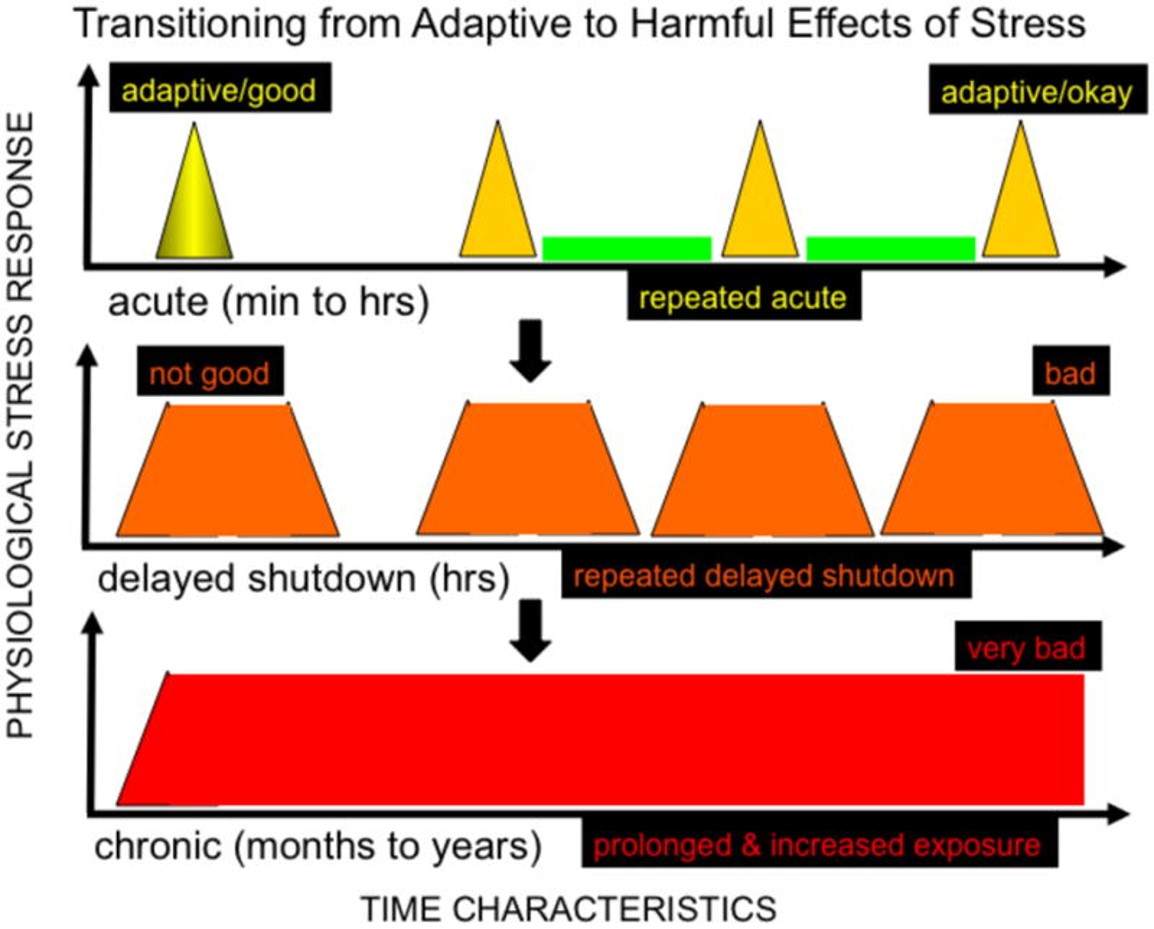
It is possible however, with busy lives, to get stuck in a sympathetic state (the middle or bottom line), in which the SNS is chronically activated. This has negative implications for health and mental health.
Thus Step 1 is about adding activities to your day that activate the PNS, that is, activate rest states. You’ll know when the PNS is ‘on’ because you feel relaxed, connected, and after a period of time restored and energised.
Activities that potentially activate the PNS are many and include:
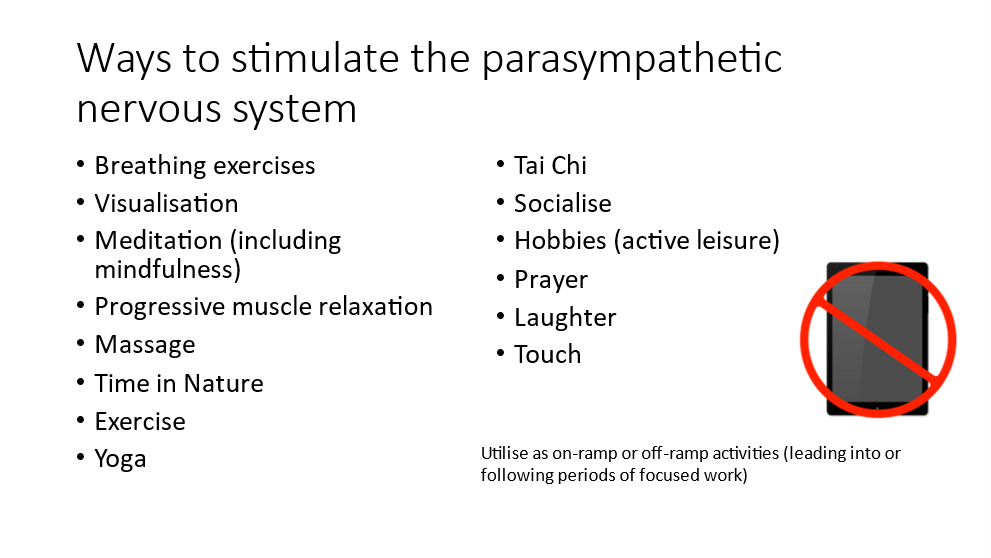
You can find instructions for some of these online. For example, a search of ‘relax and breathing’ on YouTube can find you this channel, which posts many different breathing techniques for relaxation – https://www.youtube.com/@TAKEADEEPBREATH
It is important to make a distinction between activities that reduce stress temporarily through distraction (e.g. scrolling social medial) versus activities that are genuinely restful and restorative. It might take some trial and error to work out which are which. I spent a long time thinking that my YouTube binge sessions were ‘relaxing’ but in reality they just kept me wired. There is a big difference between 20 minutes of watching YouTube, versus 20 minutes sitting in my garden. With that in mind, it is probably a safe bet that if it involves a screen, it isn’t truly restful (unless you are watching a visualiser as part of a breathing or meditation task).
So how many of these sessions, how long and when?
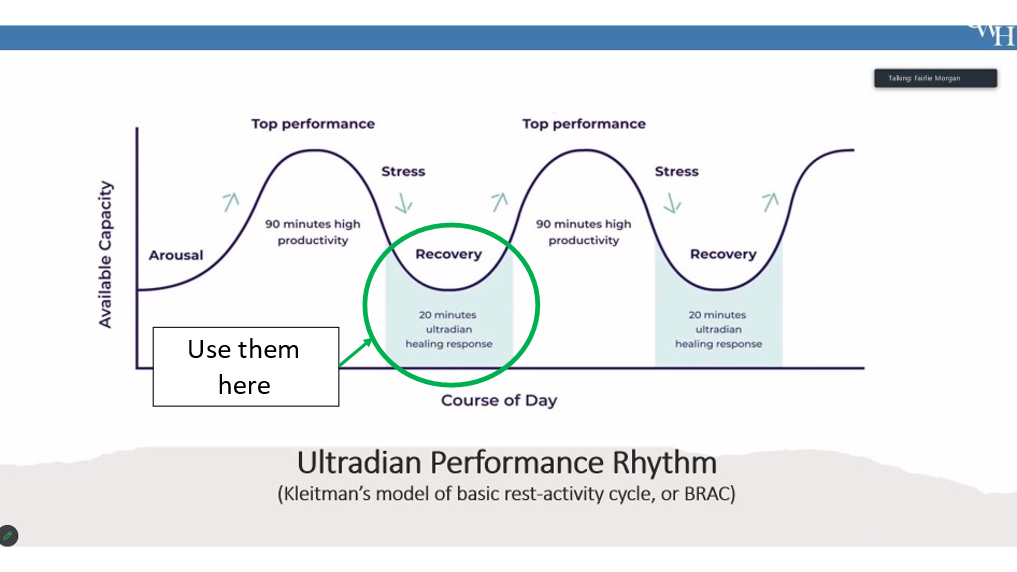
You are generally looking to add these activities after periods of focused work. 20 minutes is ideal, but even just brief rest periods over the course of the day can add up. It is about trying to get into the habit of purposefully adding restful activities to the day, and not just always relying on sleep as the primary rest time.
Step 2 – other mentally healthy habits to add to your day
There was a nice piece of research that came out in 2022 that I have talked about previously on the blog and mention a lot in my presentations – https://blogs.flinders.edu.au/student-health-and-well-being/2022/08/22/the-small-things-you-do-on-a-daily-basis-can-positively-influence-your-mental-health/
In short, that research found that people who reported positive mental health, also reported engaging more often in the following daily habits, which have become known as the Big Five:
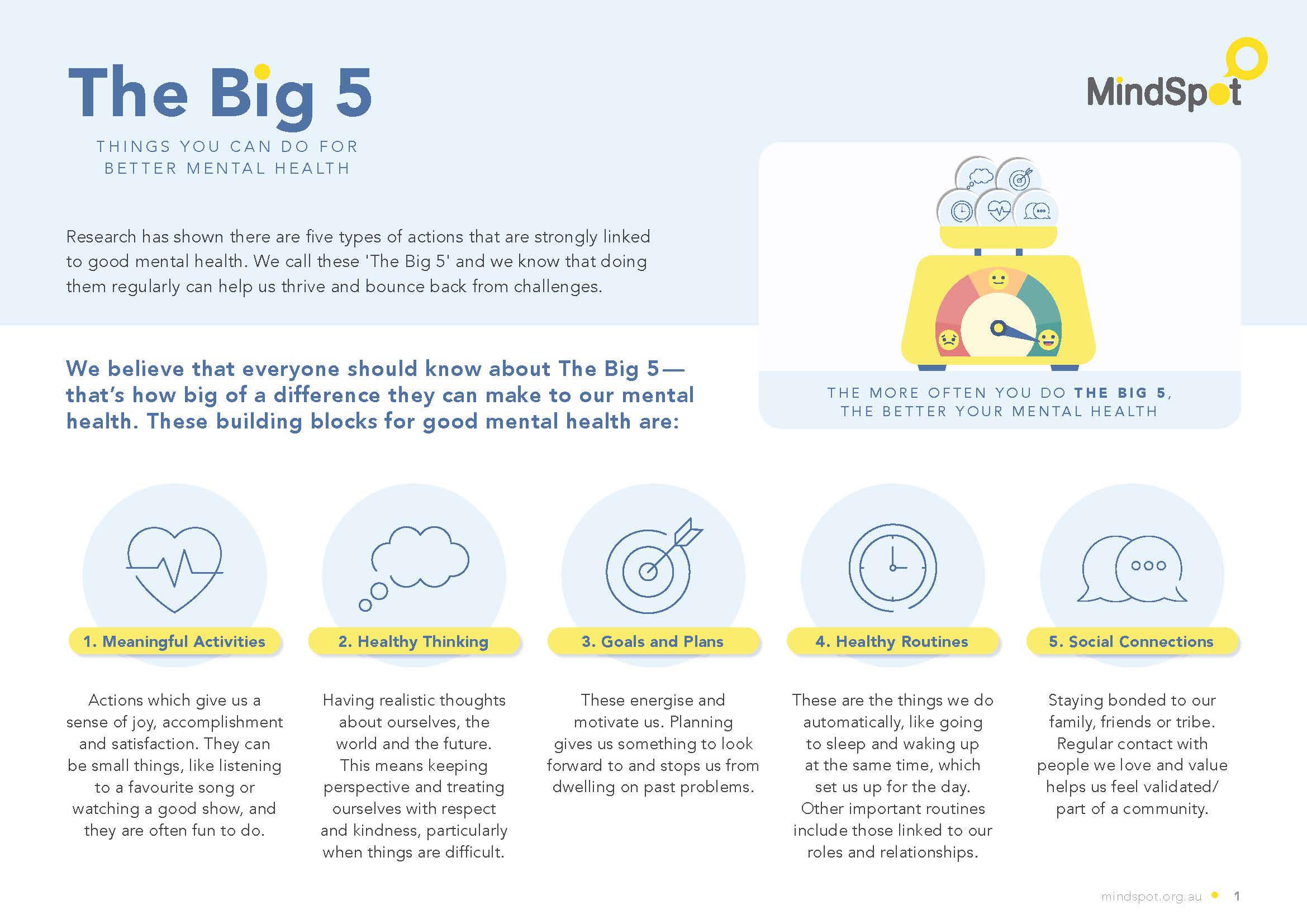
There is a self-assessment sheet you can access that provides suggestions on what those 5 habits look like in practical terms. Here are some additional ideas:
Meaningful activities – even if it is just 30 minutes, a few times a week, find and pursue a passion project
Realistic thinking – start a journaling habit and finish the day with a reflection on what happened and how you can view those events from different perspectives
Goals and plans – think about the different domains of your life and set goals in each of those domains. Translate those into goals/tasks for the day
Healthy habits – make small and regular improvements to your diet, levels of physical activity and sleep habits
Social connections – share something about your day with a friend, family member or colleague/peer
If you find success in adding stress reducers to your day (Step 1), see if you can add some of these other mentally healthy habits as well. You can visualise a daily planner and imagine placing these different habits at different points in the day. For example, you might start the day with some goal setting. End the day with some reflection on your thinking. Set aside times of the day/week for social or hobbies. Build in relaxation activities between bursts of work.
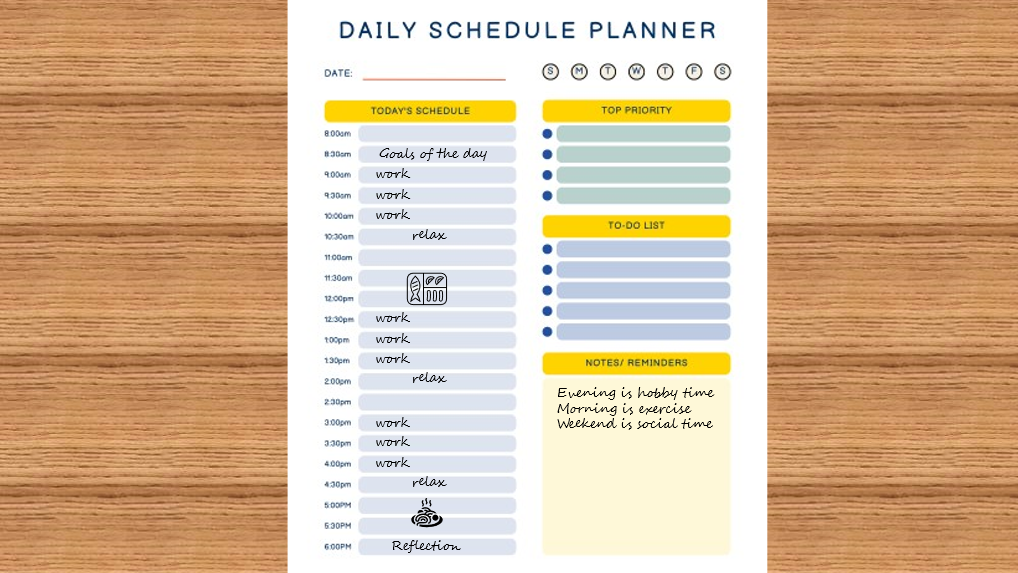
You don’t need to add all the strategies at the same time. Consider it a long-term project where you make gradual upgrades, determine if they are helpful and keep the ones that are.
Step 3 – personalise your mental health plan
If you’ve followed Steps 1 and 2, you may now have a few additional activities built into your day that are about your mental health. Nice work!
For many, the slow and steady building of these mentally healthy routines is what provides the foundation for good mental health over time. You may not need much more than these.
In the Be Well Plan that collection of daily/weekly mentally healthy habits is called your Be Well Plan. It’s like any other plan that you have in life – your exercise plan, your financial plan, your study plan. It is an increasingly clearly articulated description of how you are looking after your mental health.
In Step 3, you can start personalising that plan to address the idiosyncratic challenges of your life. What do I mean by this?
Up till now, Steps 1 and 2 have focused on you developing practices that are generically beneficial, that is, known to work well for most people, most of the time.
But each of us has our own unique challenges that relate to the specifics of our life. For one person that might be feeling socially isolated. For another person it is coping with chronic illness. Another person might be a carer and is struggling with the challenges that come with that.
In Step 3, you seek out strategies and resources specific to those challenge areas. You reflect on what aspects of your life you want to change. You educate yourself through books, videos, podcasts, courses, workshops, seminars and consultations with health professionals on how to make those changes. You then experiment with translating that knowledge into daily and weekly habits, much like Steps 1 and 2.
I went through a version of this in my mid 30’s when I got very interested in personal finance and tried to learn as much as I could on the topic. It led to changes in how I save, spend and invest and translated to a greater sense of security.
Whilst this step is easy in theory, it can be complex in implementation. It can take a while to really work out what you want to change, how you might go about it, and to gain the necessary knowledge and skills to do so. It can be hard to find reliable and trustworthy experts to guide you in the process. Some changes may be lifetime projects.
But the core of Step 3 is the deliberate acquisition of knowledge and skills to help you tackle the unique challenges of your own life.
Step 4 – deep diving on your mental health
Step 4 is for those who suspect they need additional assistance with their mental health.
This is often indicated by particular mental health experiences that aren’t improving, despite your efforts. For example, the person who finds themself constantly anxious or depressed and can’t seem to change those states.
Step 4 is typically initiated by seeking help. In Australia, the first point of call is often your GP. They can rule out other illnesses and facilitate a referral to a relevant mental health professional. Other good starting points include the Head to Health website or a site like Beyond Blue.
Stigma, fear, worry or embarrassment can get in the way of someone asking for help, particularly when it comes to mental health concerns. I think sometimes we want to prove to ourselves and others that we can ‘do it on our own’. I am certainly guilty of that. But it can mean people delay asking for help for a longer time that necessary.
The thing is, we have treatments for different mental health problems and generally, the earlier we implement them, the better. And you might think – ‘well I can do that myself’ and to an extent you are right. Steps 1-3 for example can definitely be led by you. But if your suffering is at a point where you feel your toolkit for coping isn’t sufficient, seeing a professional is a great way to upgrade that toolkit.
[As an aside, it’s a bit complex to explain, but the dynamics of mental health often mean that it is within caring relationships, including professional relationships, where psychological healing is done. Reaching out isn’t a sign of weakness. It is a natural part of the healing process].
It is also worth noting that you might not need a lot of professional assistance. You might just need a few sessions with someone to help you reorient and then you are on your way.
All this said, if you aren’t quite feeling ready to reach out to a person, know that in Australia we have lots of online mental health supports. You can do full therapy programs, right from your laptop or phone. eMHPrac currently track all of those different programs here.
Summary
I hope these 4 steps provide a more workable description of how one might invest in their mental health.
Obviously, there is more detail possible in each of the steps, so if you’d like me to write more on any of the content included above, let me know.
Otherwise, take care y’all

 Dr Gareth Furber